

From Documents to Decisions: The Business Value Behind Leap.
By: Johann Swanepoel | July 1, 2026
Gerrit’s article tells the story of where Leap started, fragile documents, complex pages, and the challenge of understanding what information was hidden inside them.
From a business perspective, that story matters because every organisation faces the same challenge in some form.
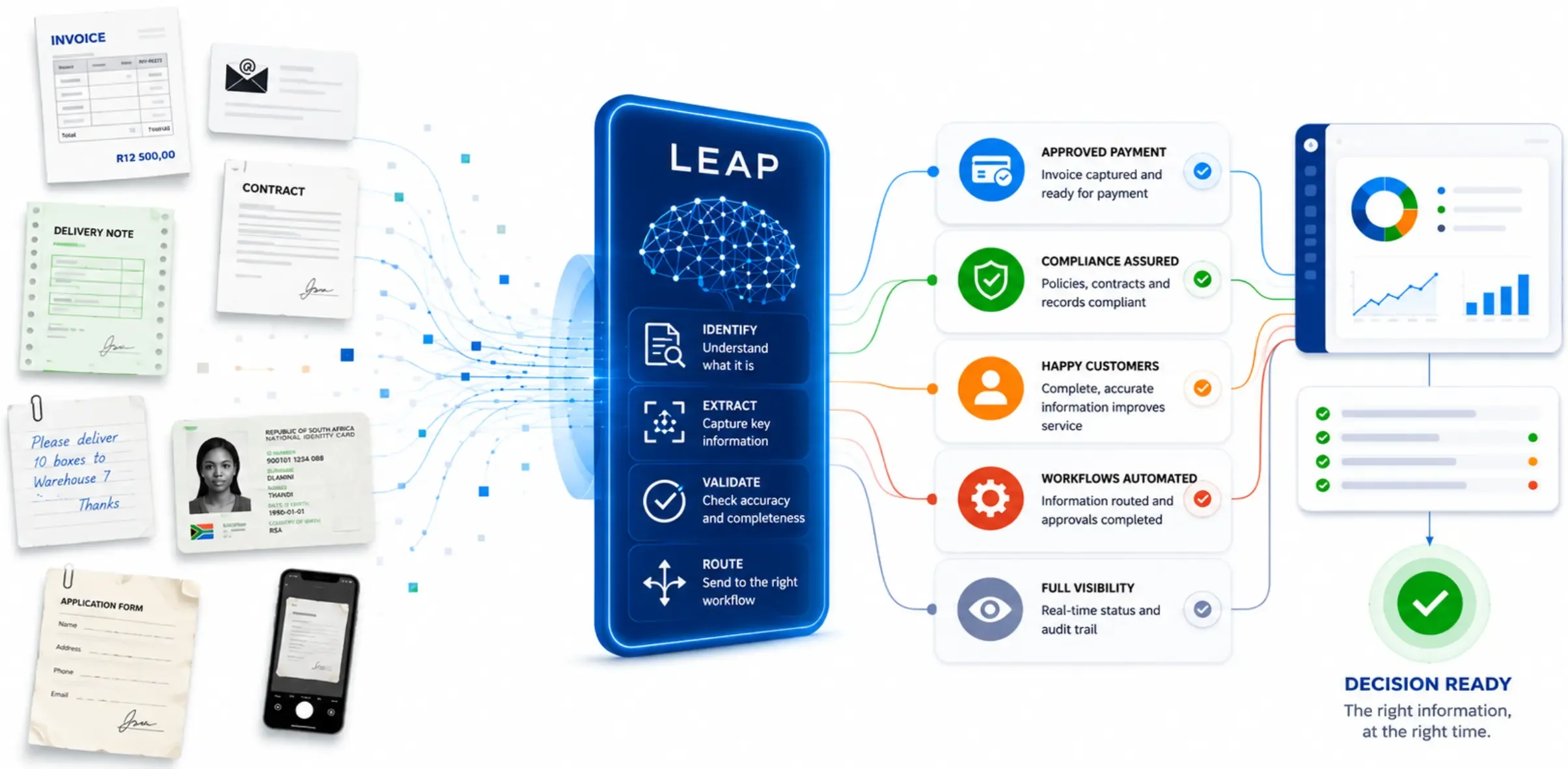
Information enters the business every day through invoices, claims, delivery notes, employee files, contracts, application forms, emails, scanned images and archived records. Some documents are clear. Many are not. Some follow a standard format. Many arrive differently every time.
The issue is not that businesses do not have information.
The issue is that too much of that information is trapped inside documents.
When information is trapped, the business slows down.
An invoice that is not processed affects payment and cash flow. A delivery note that is missing affects billing. A contract that cannot be found affects risk. A customer file that is incomplete affects service. A record captured incorrectly affects compliance.
These are not only document problems.
They are business problems.
For many years, document processing was seen mainly as administration. Documents were scanned, stored and retrieved when needed. That still has value, but it is no longer enough.
Businesses today need more than a digital copy. They need to know what the document is, what information it contains, whether that information is correct, and what action must follow.
That is the shift from digitisation to intelligence.
Digitisation makes the document visible.
Intelligence makes the information useful.
This is where Leap creates business value. It helps organisations move from handling documents to controlling information. It supports faster processing, better accuracy, improved visibility and reduced manual effort.
It also allows people to work where they add the most value.
People should not spend their best hours searching for fields, retyping information or repeating the same checking tasks every day. Technology should carry the repetitive work. People should focus on exceptions, judgement, customer service, quality and improvement.
That is not replacing people.
It is using people better.
This matters especially in South Africa, where documents are often not perfect or predictable. Businesses work with poor-quality scans, photographed ID documents, handwritten forms, old records, mixed formats and documents that have passed through many hands before reaching the process.
A solution that only works on clean, perfect documents is not enough.
South African businesses need technology that understands real-world documents and still turns them into usable information.
They also need privacy, security and compliance built into the process. Documents often contain sensitive personal, financial and operational information. That means intelligent processing must be local, controlled and responsible by design.
The business case is clear.
Leap helps turn volume into visibility, documents into decisions, and manual pressure into managed workflow.
Gerrit’s story explains how Leap was built.
The business story is why it matters.
Every organisation has document chaos somewhere. It may sit in inboxes, storage boxes, filing rooms, shared drives, scanned images or disconnected systems. The starting point may be messy, but the outcome does not have to be.
Documents are not just records.
They are business information waiting to be used.
And when that information is unlocked quickly, accurately and securely, the business becomes faster, clearer and more in control.