

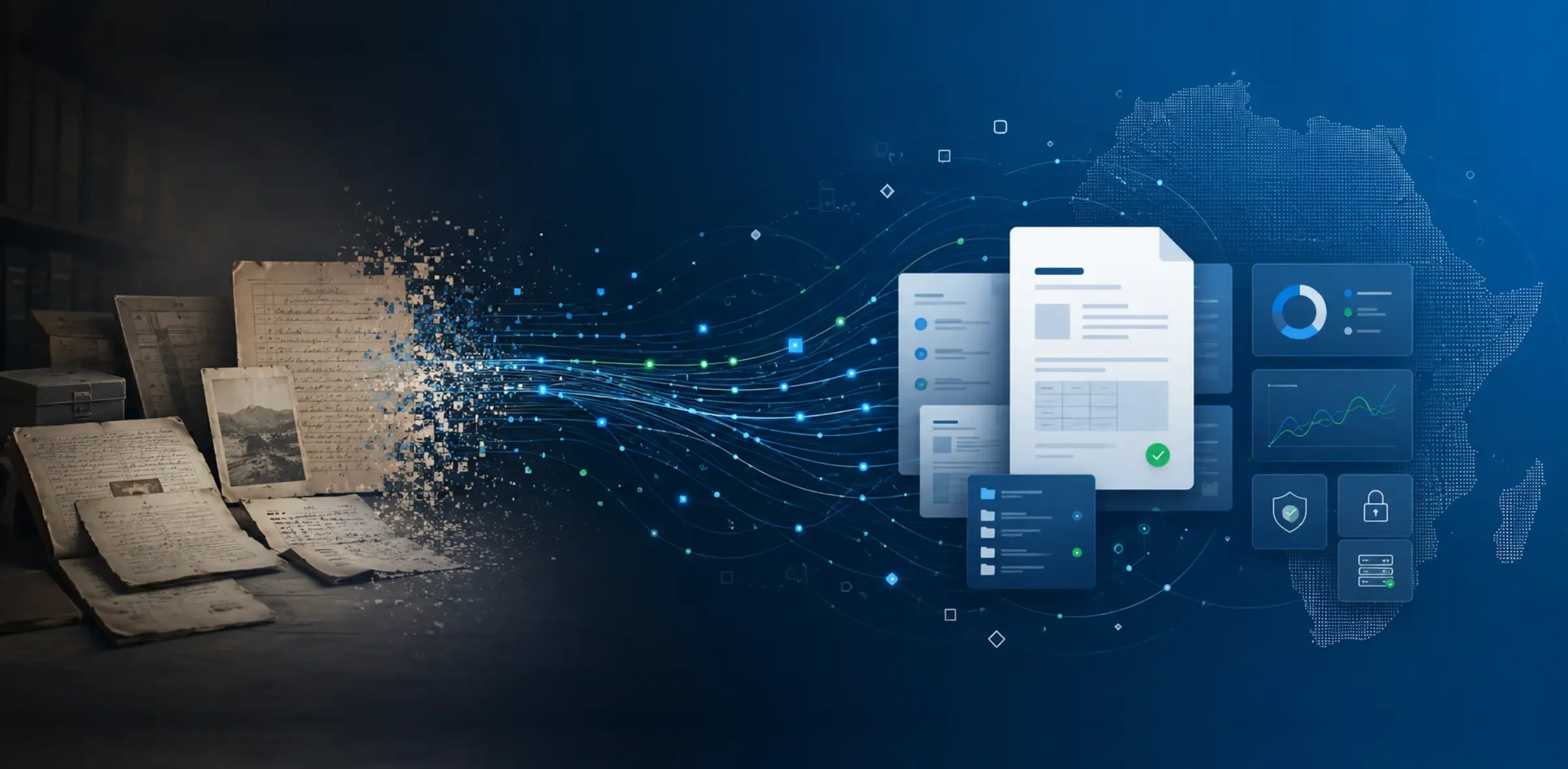
From Documents to Decisions: Why We Built Leap as a Complete, Intelligent Pathway.
By: Gerrit van Dyk | July 1, 2026
In 2014 we took on a project that I still think about. The artefacts were very old and very fragile, every page a different size and far too delicate to feed through a scanner. The only way to capture them was to photograph each page by hand. From those photographs we ran five server machines to pull out the data, stitch the pages back together, and rebuild the originals as books.
It worked. But it taught us something. The hard part was never the scanning. It was making sense of what the documents actually held.
Two more projects made the point. One asked us to extract data from lab reports. Another asked us to read incoming email and process the invoices inside it. Different documents, different sources, the same lesson each time. Scanning a page or reading an email is the easy part. The value sits in what comes next: knowing what kind of document you are looking at, finding where the data lives on the page, and pulling it out correctly even when the input is messy.
So we stopped building one-off solutions and decided to build a system. Something that looks at a document intelligently, identifies it, finds the data wherever it sits, and extracts it, whatever shape it arrives in. We brought together the tool sets we had been refining on each project, and over time that became Leap.
Leap is built to be configured, not rebuilt. The client, the department and the document type all shape the system to their needs, rather than the other way around. To date it has processed more than 500 million pages successfully. That is the number I am proudest of, because every page in it was a real document from a real organisation, with all the wear and inconsistency that comes with the real world.
That history is also the philosophy. Leap exists to carry the drudgery so people can do the work that needs a person. The machine does the reading, the sorting and the first pass at the numbers, at a scale and speed no team can match. The person does the judging. When something is unclear, a human looks at it, decides, and moves on. We call that effortless intelligence, and it is not a slogan. It is a description of who does what.
It matters most here at home. South African organisations do not work with tidy documents. We see faxed copies of faxed copies, ID books photographed on a phone, and forms filled in by hand in three different pens. Leap was built and tested on the documents we actually receive in this country, not the ones a brochure imagines.
Today we are taking the next step. We are building our own intelligent vision system, a private language model that understands your documents and knows what they are without ever leaving your organisation or the country. Everything stays local and private. We are building it for South Africa and for the privacy our documents demand, with nothing sent to a cloud beyond our borders. That means our clients and their documents stay fully compliant with South African law, by design rather than by promise.
This is how we work. No challenge is too large for us. There is always a way, and we are committed to looking closely at each client's needs and providing solutions that fit. Tailor-made for the client in front of us, not the product that gets sold off the shelf.
Document chaos is not the customer's fault. It is simply the starting condition, and our job is to turn it into clarity, reliably, every day. We started in 2014 with a camera, five servers and a room of fragile pages. We are proud of where that has taken us, and we are certain this is only the beginning.